Sunday, May 08, 2011

New faces but not necessarily young

Does such lethargic mass generate political inspiration to the masses?

In the Kota Kinabalu UMNO Divisional Annual General Meeting, the UMNO Kota KInabalu Division Chairman, Datuk Faisyal Y. H. Diego suggested that candidates for the upcoming general election should come from among the young leaders in Wanita Umno, and Puteri and Umno Youth wings.

Ketua Puteri UMNO leader agreed and expressed support from her wings. She suggested 50% must come from the young ones.

In case, you are not aware there exist a Puteri UMNO. The Ketua Puteri is that lethargic mass and most unhealthy looking Deputy Health Minister, Dato Rosnah Abd Rashid Shirlin you sometime see on TV.

These suggestion may have it's basis but judging by the present crop of poor quality and attitude of leaders generated from the Pemuda and Puteri wing, that spells D-I-S-A-S-T-E-R in the making.

The analysis concluded from the many by-elections, especially the ones UMNO and BN won, shows that it is new faces that the electorates wanted. Voters grouses are against the usual offerings from the past with baggage of bad habits, laziness and arrogance.

This was also proven in the last Sarawak state election. Pehin Seri Taib Mahmud opted to replace the old faces with new faces rather than the young faces.

He did not allow for a major generational transformation that would come with 50% replacement with new and young faces. Voters do not care if you are young or old but they want a working representative.

That helped him win the two third majority despite the onslaught he was facing.

Read the Bernama news below:

May 07, 2011 20:29 PM

Puteri Umno Supports Suggestion 50 Per Cent BN Candidates Be From Among Young

KOTA KINABALU, May 7 (Bernama) -- Puteri Umno backs a suggestion that 50 per cent of Barisan Nasional (BN) candidates for the 13th general election be from among the young.

Health Deputy Minister Datuk Rosnah Abd Rashid Shirlin, who is also national Puteri chief, said the backing reflected the 45 and below age category of 70 per cent of voters in the general election.

Indicating that these voters were more likely to vote for candidates in their age group, she said they would be the ones to decide the outcome of the election.

Kota Kinabalu Umno division chairman Datuk Faisyal Y. H. Diego made the suggestion during its Puteri delegates' meeting here Saturday.

He said the candidates could come from among the young leaders in Wanita Umno, and Puteri and Umno Youth wings.

Rosnah, while opening the event, told Puteri members to make it their priority to help prepare the BN for the coming general election.

Among others, she urged Puteri members to have Facebook and Twitter accounts and blogs as a means to get to the target group. -- BERNAMA
The major issues against this suggestion is the level of activities and drive coming from the Pemuda and Puteri movement.

They are expected to be in the forefront of political events and happenings and doing the grunge work but are acting and acquired the indolence habit of veterans. The presence of Pemuda and Puteri in by-election campaigns slips by everybody.

Under the present crop of Pemuda and Puteri leadership, both the movements are seen as lifeless, overly cautious and clueless. The intra-organisation politicking at their level is so endemic that it stiffled activities at all levels.

In comparison to the level of maturity and seriousness of past generations of Pemuda UMNO leadership, the current Pemuda and Puteri does not come close to their feistiness. Being feisty is not about being combative only.

Perhaps they are tamed by the more welfare and social nature of political work these days. In the past, Pemuda political work carry on a more serious tone in the struggle to address social, political and economic issues pervading the Bumiputera community and nation.

But, perjuangan belum selesai. They must find their role and not as we see today of Pemuda and Puteri leaders more keen in eyeing for positions in GLCs or setpols or even set-pol to a set-pol. Pemuda and Puteri social gatherings are more like business networking gatherings.

Where lies Rosnah's leadership when she can't establish
working relation with her deputy?


On an individual level, Pemuda and Puteri could neither command the respect of their piers or elders nor entrusted with specific task by their party's elders anymore.

The Ketua Pemuda's attitude is something to be desired. Just because he was not selected into cabinet, he is whining and pleading like a spoilt mama's boy. Instead of working hard to convince the party elders, the Ketua Pemuda's reaction is to sulk by standing down the Pemuda machinery at the party's expense.

To give him some leeway, why in heaven's should that irrelevent fat slob Rosnah be given a position in cabinet when she could hardly established a working relationship with her deputy and make Puteri into an organisation with some form of existence.

Imagine, without any inkling of leadership, compassion and maturity, they expect 50% of the seats to be given to candidates from Pemuda and Puteri?

At the level where they are being nurtured as future leaders, these boys and girls have acquired many bad habits and attitude and taking it easy as as though they are senior party members.

To suggest they are to be empowered, it is crazy and irresponsible!

Singapore Election Results: Is the warlords in UMNO reading into it?


Unless Siti Nurhaliza is finally pregnant and that grab the headlines today, the big story today should be the Singapore Election results:

Singapore's ruling party loses multi-seat constituency

Sat May 7, 2011

SINGAPORE (Reuters) - Singapore's long-ruling People's Action Party (PAP) suffered its first-ever loss of a multi-member constituency, handing the opposition Workers' Party five of the 87 elected seats in the city-state's parliament.
Singaporeans voted on Saturday in the Southeast Asian country's most hotly contested general election since independence. Although the long-ruling PAP has won the election with more than two-thirds of the seats, its share of the popular vote fell to around 60 percent.

At the last election in 2006, the PAP won about 67 percent of the vote and 82 of 84 seats.

The loss of the five-member Aljunied group representation constituency (GRC) means Prime Minister Lee Hsien Loong will have to appoint a new foreign minister to replace George Yeo, a member of the PAP team contesting the constituency.

Second Finance Minister Lim Hwee Hua is another member of the losing PAP team.

The Workers' Party team was led by secretary-general Low Thia Khiang and included top corporate lawyer Chen Show Mao, managing partner of the Beijing office of U.S. law firm Davis Polk & Wardwell who advised on many of China's multi-billion-dollar initial public offerings.

The PAP government introduced the GRC system in 1988 saying it needed to ensure minority candidates from the city-state's minority Malay and Indian communities were represented in parliament.

Opposition parties, however, contend the GRCs, are aimed at making it more difficult for them to win seats under Singapore's first-past-the-post electoral system.

The PAP has never lost a GRC since the system was introduced in a 1988 election.

For the current election, the city-state was divided into 15 GRCs of four to six seats each, and 12 single member constituencies.
Something worth noting for us and UMNO/Barisan Nasional should realise this important phenomenal change:


Young voters speak their minds

Sunday, May 8th, 2011
The Star

A record 2.2 million Singaporeans cast their votes yesterday in the country's most-fiercely contested general election to date. Some used the ballot box to get their message across.

GENERAL elections have always been a great excuse for Jess to throw a party.

Friends, their spouses and children normally gather at her place to help themselves to a yummy home-cooked buffet dinner while watching the live telecast of election results.

It has always been a fun affair. But this time, Jess is not having her usual election party.

Two of her closest friends have refused to come. They are die-hard PAP supporters and annoyed that Jess and her husband are backing the opposition and being so open about it.

So, to save their two-decade long friendship, the couple decided to go to different election parties this time around.

“I want to let loose and shout each time the opposition wins. Over the past two weeks, our friend Xavier has been lecturing us all about the good things that PAP has done. It's getting a bit boring.

“It's like he is more PAP than even PAP. So just for today, I don't want to be around him,” Jess said yesterday after casting her vote.

This is the first time that Singapore is facing such a fiercely contested election.

There are 87 seats in parliament but the PAP won five seats uncontested in the Tanjung Pagar constituency even before polling day as the opponent party's candidates were 35 seconds late in handing in their nomination papers. This left 82 seats up for grabs. And this is the first time this many seats have been contested.

While voting is compulsory in Singapore, a number of people in their 30s and 40s have never voted before because there has always been a walkover in their constituency.

So, it is a first for them and they are understandably delighted to be at the polling centre to have their say.

“I am glad that my one vote counts finally,” said 39-year-old Lim, who voted in Bishan-Toa-Payoh. The constituency has not seen a contest since 1997.

Yesterday, a record 2.2 million Singaporeans cast their votes compared to only 1.2 million in the 2006 elections when 47 out of 84 seats were contested.

Because of their lack of “practice” in voting, there are postings on websites, Facebook, Twitter and even on TV telling and showing Singaporeans how to cast their vote.

Some can be amusing like the one posted by theonlinecitizen on Facebook.

“Please remember: You are suppose to put a CROSS X in the box next to the symbol or logo of the party you want to vote for. PLEASE do not put a tick or draw a picture or write anything in the box. Otherwise your vote may be discounted. PLEASE also do not spoil your vote....”

Khor, a businessman, flew back from Penang to cast his vote in Tampines. He is considered quite a “pro”, having voted in three previous elections.

“PAP has been doing well but there is a need for improvement here and there. The stakes are too high for us to change.

There are things I don't like about the PAP government, like them increasing the retirement age, not letting us take out all our Central Provident Fund savings and giving us only S$300 (RM726) a month which is pathetic.

“This has messed up many people's retirement plans. But better the devil you know than the devil you don't. My vote is for stability,” he said on his way to his polling centre.

Singapore is a model country. Despite its lack of natural resources, the country which emphasises excellence, meritocracy and competitiveness has been able to grow into the most-developed nation in the South-East Asian region in just a matter of 50 years.

It has grown by leaps and bounds and today, it is able hold its own among other Western developed countries.

But this has come with a price. Singapore is a tightly controlled country, where spraying grafitti and stealing road signs can get you jailed and caned for vandalism!

There is very little freedom of expression in Singapore and people are afraid of speaking their minds for fear they will be penalised.

Despite its impressive double-digit economic growth rate, Singapore ranks among the bottom (136 out of 178) in the World Press Freedom Index.

But as the world becomes more globalised and connected, young educated and IT savvy Singaporeans have become a bolder lot.

They won't accept “because-I-told-you-so” type of answers. They want logic, reasoning and for both sides to present and argue their case. And they have found a voice through social media on Facebook, Twitter, blogs and other websites.

Young voters make up about 10% of the voters. And the ruling PAP can no longer afford to ignore their voice.

Even Prime Minister Lee Hsien Loong has acknowledged how important it is to engage the young. Three days to polling day, he went on Facebook to “chat” with the country's youths.

“Hi, I'm Lee Hsien Loong

Welcome to my webchat!

This is my first time doing this

So please don't flame me, I'm a newbie :-H)

I see many of you are interested in how we can engage youths more

Shall we start with this?
In that hour-long chat, comments kept flowing in with some people saying how cool' it was to see their PM on Facebook and how they respect and salute him for what he is doing for the country.

But others posted tough questions like asking him to justify the “sky-high” salaries of the Singapore ministers, the building of casinos, the high cost of goods and public (HDB) housing.

It isn't just the youths or young voters who have been griping. There has been a lot of rumblings on the ground which came to a boil during this election.

People are upset that the HDB public housing is no longer affordable, especially to first-time home buyers and singles and are unhappy that foreigners are pushing up their flat prices and rentals.

They complain about overcrowding in buses and the MRT and foreigners competing with Singaporeans for jobs and places at universities. They worry about healthcare, retirement, their CPF savings and say PAP leaders with their million dollar salaries have lost touch with the realities on the ground and become arrogant.

A number want to teach PAP a lesson or send them a message.

And it helped that the opposition has candidates of high calibre this time, such as corporate lawyer Chen Show Mao (Aljunied constituency), investment adviser Tan Jee Say (the former principal secretary to Senior Minister Goh Chok Tong), psychiatrist Dr Ang Yong Guan (both contesting in the Holland Bukit Timah constituency and top government scholars like Tony Tan and Hazel Poa (Choa Chu Kang).

Fred, a parent, claimed PAP has forgotten about Singaporeans.

“I pay taxes but have to send my kid to Australia to study because there are no more places at the university here.

“Then I see Singapore giving scholarships to foreign students to study at our universities. This is our taxpayers' money paying for the foreign students, so how do you think it makes me feel?” Fred asked.

Jess' husband, Samuel, is an engineer drawing S$10,000 (RM24,205) a month.

“Singapore ministers are the highest paid in the world, getting more than S$1mil (RM2.4mil) each a year.

“Our ministers are paid more than the US president (who gets US$400,000 which is RM968,220)! Does this mean that the job of our ministers is tougher than that of the president of a superpower? You can't blame us for having very high expectations on them to perform.” On Tuesday, after a feel of the rumblings and anger on the ground, the Prime Minister made an unprecedented apology to Singaporeans for all the shortcomings and promised to do better.

While some believed in his sincerity; others said it was a little too late and a desperate move to fish for votes.

Polling closed at 8pm last night, and even at midnight the first official results had yet to trickle in.

While each political party held its own get-together election results parties, some individuals like Jess prefer home parties with friends.

The New Paper Sports Bar opted to screen the election results instead of sports, a first for them.

But other Singaporeans aren't holding their breath.

“I'd rather watch football,” said Khor, holding his hands up in triumph.

Whatever the outcome and whatever the margins, Singapore's political landscape is changing.

Will this trend emanating from the youth continue to spread in Malaysia? If it does, this is a glimpse of what is coming.

Does the UMNO leadership realised this? At least, Prime Minister and UMNO President Najib is active and seriously pursuing this. Not quite sure for the rest.

Maybe there must be some serious consensus or policy making at Cabinet or party level on cyber engagement by Member of Parliaments and Cabinet members.

Does the warlords and power gatekeepers dominating their presence at and behind the positions at the divisional and branch level take heed? Many does not even keep abreast with current and political developments and even within their area.


Umno needs daring transformation: Hisham

BESUT: Umno needs to carry out a more daring and drastic political transformation to ensure that it remains relevant under the current political environment and accepted by the people, said party vice-president Datuk Seri Hishammuddin Tun Hussein.

He said that at the same time, Umno must also continue with the tradition of listening to the woes and demands of the people and to meet these demands.

"We are fortunate that, by meeting the demands of the people much earlier, we were able to avoid the situation occurring in other countries such as in the Middle East

"The opposition made their move prematurely. They staged street demonstrations much earlier, protesting against the ISA (Internal Security Act) and they intended to seize Putrajaya on Sept 16 (last year), but they were unsuccessful because we had implemented what the people desired," he told reporters after opening the Besut Umno divisional delegates meeting, here Saturday.

Also present were Besut Umno division head Datuk Seri Idris Jusoh and a representative of the Terengganu Umno Liaison Body, Datuk Wan Ahmad Farid Wan Salleh. Earlier in his opening speech, Hishammuddin, who is also the Home Minister, said Umno leaders and members must strive to strengthen the party's struggles and be prepared to face the opposition parties in the 13th general election.

He said this was appropriate as the parties in the opposition pact were now at loggerheads with each other.

He said that Umno should also not fear PAS, which was now divided and had lost in several recent by-elections.

"We are not afraid of PAS, they are now divided. This shows how brittle they are in facing the BN (Barisan Nasional) which is bold, sincere and honest in championing the cause of the people and country," he added. - Bernama
Sic ... 3 years and 3 months after March 8, 2008 General Election and facing an upcoming General Election, an UMNO Vice President is still talking of transformation?

Lemau lemau
...

Unofficial result claim George Yeo lost Aljunied GRC


The Star SMS reported:
8/5 S'pore polls (unofficial): PAP team, which includes Foreign Minister George Yeo and Cabinet minister Lim Hwee Hua, has lost Aljunied GRC to WP/STAR
Asione reported here Hougang GRC is lost to Worker's party. Read here.

Have no fear the latest on Asiaone website here puts it at 37-1, in PAP's favour off course. There are 82 seats out of 87 seats are being contested involving 5 Group Representation Constituencies (GRCs) and 12 Single Member Constituencies (SMCs).

Perhaps, it is appropriate to read this report on George Yeo.
George Yeo: PAP must change

Fri, May 6th, 2011
The New Paper

SINGAPORE - If Singapore is to move forward, the People's Action Party (PAP) must change.

This observation came not from an opposition candidate, but from a PAP candidate - one who's a minister to boot.
Speaking at a PAP rally last night, Mr Yeo, who is the Foreign Affairs Minister, said his party has to undergo a transformation if it wants to engage the new generation of Singaporeans, many of whom are angry with the Government.

He admitted that there was a lot of resentment towards the ruling party because it was too arrogant and high-handed.

He said: "In your hearts, you know that Singapore needs the PAP. That without the PAP, there is no Singapore. But, we need a transformed PAP.

"It doesn't mean that all our problems will be solved, but it means that there will be better communication and a greater feeling for people."
Woi UMNO ... jangan tidor lagi.

He's talking to you too. Learn something there!

Saturday, May 07, 2011

Is PAP so desperate that they need to cheat?


Had just stumbled on the above Tweet by The Star Chief Editor, Dato Wong Chun Wai. Is it for real?

Why would it take till 6 am for their election officials to announced results when the polls closed at 8 pm?

With Singapore being bigger than Kamalanathan's Hulu Selangor constituency and about size of Tasik Kenyir in Hulu Terengganu albeit equipped with sophisticated and latest technology in telecommunication, computing, information technology and efficient transport system AND brilliant Rhodes scholars and Ivy Leaguers, that is hard to believe.

The recent Sarawak election with limited acccessibility in some areas could get the results in by late evening.

That was Wong CHun Hai's Tweet 15 hours ago.

This morning there was a commotion with regards to NSP candidate for Marine Parade GRC Nicole Seah. Read here at Temasek Review here.

In the meanwhile, Anil Netto's latest tally here is 5-0, PAP lead.

Singapore Election 2011: Something light, something for thought and something serious

Here is something light ...


Something for thought ...
Are Singaporeans capable of a political tsunami?

Singaporeans go to the poll come Saturday. My answer to the question above is an emphatic 'YES'.

But here is the catch: When? I believe in the capacity of human society to correct itself. We had it in Malaysia in 2008.

Just this year, we witnessed the most surprising ones in 'Arab Spring'. No matter how hopeless the situation, people will always rise; it's only a matter of time.

To Singaporeans, the term 'political tsunami' needs further elaboration. When Malaysians did it on March 8, 2008, Malaysia did not have a new government.

Nor were there racial riots or economic collapse as some scaremongering people would like us to believe.

But after the BN lost its coveted two-third majority and power in five states for the first time in so many years, the political and governance situation in Malaysia has changed beyond recognition.

Competition in politics and policies becomes real, only to the benefit of the people. Not only has the federal government under Najib innovated itself on new economic initiatives, it has also gone out to reach all segments of the society.
Every vote now really counts. The opposition is also given the chance, albeit in limited way, to prove itself in governing through the five opposition states.

Competition of ideas in a healthy democracy has seeded in Malaysia. The growing-up process is surprisingly less painful than previously thought.

Singapore has been governed by a single party, People's Action Party (PAP), under the heavy hands of Lee Kuan Yew for over 51 years.

While he has stepped down from the prime minister position in 1990, Singapore today is still very much an LKY's Singapore.

Through two successive prime ministers, the only change is his job title, from senior minister to minister mentor today, with his son Lee Hsien Loong helming the post of prime minister.

Politics remains backward, in stark contrast to other areas of the city state. Its Parliament is a record 82-2, two opposition members versus 82 of PAP.

The Singapore economy has been charging ahead, even surpassing itsneighbour Malaysia, which is a much larger country and resource rich, in GDP size. However, its economy is one that relies heavily on foreign labour.

Some people even call it exploitation of cheap foreign labour. Such a formula of economic success means a more volatile society and widening of income gap between the poor and the rich.

Rising costs of living, especially in the heavily government-controlled public housing, causes much dissatisfaction on the ground.

I have been living in Singapore for more than 16 years. Last week during the lunch in a public sector forum attended by many senior Singapore civil servants, I was surprised to hear the comment of a senior officer of the CPF Board.

He did not mince his words: "If Singaporeans fail to vote in the opposition this round, they are doing a disservice to themselves and Singapore."

His point was, Singapore other than its GDP, is in bad shape and the opposition has put up a united front this time around with the most credible candidates.

To me, that's a shocking comment. The truth is, fear is still prevalent among Singaporeans despite the thickening dissatisfaction.

Fear in two ways: fear of the government for those who want to vote the opposition, and fear of an uncertain future for Singapore should the PAP's wings be clipped, or even a change of government.

For someone in his position sharing his political view to his new acquaintances is very telling. I started to feel the fermentation of a political tsunami in Singapore, although admittedly a rather wishful one at this stage.

Weeks before March 8, 2008, I was driving up and down the North-South Expressway to Kuala Lumpur from Singapore, involving myself in my desperate effort to help the opposition.

I would even stop by the rest stations to distribute campaign leaflets I had printed myself.

Like many other fellow volunteers, we were driven by self-conviction of what's right to do, without holding out hope of a positive outcome.

In fact, I had fear when I did my rounds at those rest stations, scared of being confronted by the police or Umno hooligans. Many other volunteers went the extra mile under even more fearful situations.

But on hindsight, we now realise that it was such collective conviction overcoming fear that has helped to bring about the political tsunami.

Singaporeans can learn from the experience of Malaysia's political tsunami. Change can be positive, especially if the society is determined to have it.

And change should not be equated to pessimism, although the establishment wants us to believe it so.

On the contrary, the long rule of PAP has created a Singapore that has deprived its society of a healthy debate of ideas, openness and independent thinking.

One doesn't have to search hard to understand why it has been struggling in the global knowledge-based economy, which competes not on efficiency but on innovation and creativity.

On the other hand, every day Singapore goes on a system without checks and balances under the absolute rule of PAP is simply growing its risk of a fatal national mistake in the hands of a few ruling elites.

The smaller the collective decision making body, the higher the risk of a fatal mistake. In other words,

Singapore has been living on luck for far too long. The recent massive losses from its state investment arm Temasek is already an early warning.

It is ironic but logical to argue that only a political tsunami will ensure Singapore a certainty in its future, one that's less risky but competitive in ideas.

Free Malaysiakini

Something serious ...

Friday, May 06, 2011

What change installed for Singapore tomorrow?

Workers Action Party rally at Tampines Stadium

Syed Akbar posted something on the Singapore Election here that got my attention. So did BHM Secretary, Tony Yew here. Tony will be in Singapore with other bloggers to view the elections there.

Let me share this posting from Singapore Election 2011 blog below:
PAP’s distastrous election campaign hits rock bottom

The PAP’s campaign for the 2011 election is a castastrophe right from the very beginning, plagued by incoherent messages to the voters, contradicting statements made by leaders and an outright dissociation from the reality on the ground amidst fast rising public disgruntlement at opprobrium.

For the last one week, the PAP’s disjointed campaign was dominated by two former prime ministers instead of the incumbent. PAP ‘walkover’ MP for Tanjong Pagar GRC Lee Kuan Yew used his trade-mark ‘knuckle-duster’ style to intimidate Singaporeans from voting for the opposition, in particular residents of Aljunied GRC who were told to ‘repent for five years’ if they voted for WP. Then Goh Chok Tong, who had earlier promised not to comment on candidates from other constituencies shot his own foot by making disparaging remarks about his former subordinate and now SDP candidate for Holland-Bukit Timah Tan Jee Say.

The PAP has adopted the same modus operandi it employed so successfully in previous elections by harping constantly on its ‘track record’, handing out goodies like ‘Grow and Share’ package to woo voters and using the state media to smear and fix the opposition.
It appeared to have panicked when it realized that the same old tactics aren’t working on Singaporeans anymore, especially the young who are widely read and have no affiliations to the PAP.

The oft-repeated message of ‘good governance, political stability and economic growth’ now sounds like a stale old record repeating itself to a wall especially when life is indeed getting tougher for ordinary Singaporeans facing increasing competition from the relentless influx of foreigners.

The hundreds of dollars handed out to Singaporeans are too little to help them cope with the rampant inflation while the usua smear tactics which have worked so well in the past now backfired one by one in the age of Facebook and Youtube.

Peoples' Action Party rally at Tampines Stadium

Like an over-confident student who did not bother to study hard for his exams only to realize in the last minute that the format of the papers have changed and doing last-minute revision now, the PAP is changing gear with only three days to go to salvage a disastrous campaign so far.

The format of this election has indeed changed, revolutionized by the new media which the PAP has failed to incorporate into it campaign.

All of sudden, Lee Kuan Yew who had dominated the headlines for the last few days has all but disappeared from public view altogether with Goh Chok Tong whose infamous last words were – “The majority of Singaporeans are not concerned by the high ministerial pay.”

Like an abusive husband saying sorry to a battered wife and promising to change, PM Lee went through a face-life in a day: he apologized to Singaporeans for the mistakes his government have made despite the many opportunities they were given in the last five years, tried to embrace the online community by holding a ‘Live’ webchat through Facebook when he should have done so earlier and pretending to be humble, empathetic and caring when all along he had been lecturing Singaporeans and asking them to take the ‘bitter pills.’

PAP leaders suddenly remember to engage Singaporeans instead of talking down to them. George Yeo made a desperate appeal on a Facebook video to young Singaporeans to support the PAP, promising to “change and improve” when he said in 1995 that ordinary Singaporeans have no right to discuss about policies with the government.

Khaw Boon Wan cried to win sympathy votes during a rally while conveniently forgetting his callous call for Singaporeans to send their parents to retire in Johor Bahru in 2007. Dr Vivian Balakrishnan now promises to “care for” and “look after” Singaporeans when he deliberated for months before raising the monthly allowance of Public Assistance recipients.

Unfortunately, these feeble last-ditch attempts aren’t going to convince many Singaporeans who have already made up their minds to teach the PAP a lesson it will never forget on 7 May.

Despite controlling the mainstream media, the PAP has clearly lost out to a highly motivated, tightly-knitted and nimble opposition which has clearly played its cards right this time with strong support from the new media.

In fact, the state media may turn out to be the PAP’s undoing as its blatant one-sided propaganda has lulled PAP leaders into a state of complacency for a long time.

Like domesticated dogs which have grown too fat and lazy to guard the house, the present batch of PAP leaders are so sheltered from the humps and bumps of politics that they have lost the instinct, capability and competitiveness necessary to survive in the harsh world of politics.

Though the PAP will still win the coming election with an overwhelming majority, it will be a useful wake-up call for its leader to change their usual strategy to appeal to the younger generation of voters in future elections.
The outcome will be an interesting one.

In Malaysia, sister party to PAP, the DAP is pulling it off on the incumbent and ancient Barisan Nasional campaign machinery in Sarawak.

Unlike in Singapore, DAP is accusing the incumbent Barisan Nasional for applying "the trade-mark ‘knuckle-duster’ style to intimidate Malaysian" and "making disparaging remarks" on other candidates.

DAP claimed BN "adopted the same modus operandi it employed so successfully in previous elections by harping constantly on its ‘track record’, handing out goodies" ..."to woo voters and using the state media to smear and fix the opposition."

Off course, BN's argument is opposition has a better leeway in democrasy than PAP's Singapore.

With their inter twinning history, DAP emulates Singapore in policy making, strategy and tactics, and in the areas of economics, politics and social engineering.

A decline in votes for PAP will be used by BN to claim that DAP's PAP ideals are rejected by Singaporeans themselves. If it is a true yearning for change from PAP's governance style, DAP will face questions on their transformation plan towards Singapore style governance and policy?

BN will see happening in Singapore for leads in their election preparation too.

Najib has called for UMNO to set aside past issues and work towards taking over of Selangor. That sounds like election drum beating. It could be 11-11-11, speculate some cheeky blogs.

BN may have something in common to PAP albeit to a lesser degree because of the earlier awakening in 2008.

Nevertheless, there is still significant in-denial mode and attitude still prevailing in the lower to middle party level to social and generational change undergoing in the nation. PBB and SUPP was still in such only last month.

There is a change felt but what and why.

If it is a case of clear change that is bound to happen for whatever the reason, I came out winning yesterday evening's long telephone argument.

The point was: there is social and generational change happening in Malaysia. UMNO and BN should heed it and not adopt the excuse that business remain as usual and things are only disrupted by some crank in the machinery.

UMNO and BN has not undergo that significant attitudinal change. If it doesn't, it will face the surprise PAP is facing.

The surprise could come from PAP's sister party, DAP. Momentum is on DAP side. But for the time being, it is slowed by Ketua Umum, Dato Seri Anwar Ibrahim moral issues, disintegrating PKR machinery, and morally and ideologically confused PAS.

Will the Singapore result tomorrow merely shows a global or in the case of democratically tight, Singapore, localised reaction, probably transitory in nature, due to openness from technology? Perhaps it is some unfathomable new phenomenon to change for the sake of change.

Singapore's election result tomorrow will be interesting ...Read for the latest from Singapore Election Watch, Singapore Election 2011, The Online Citizen, and Temasek Review.

Happy voting Singaporean!

Tuesday, May 03, 2011

Politicking and partisan divide counter productive to public interest

"Excessive politicking and partisan divide is not helping the country move forward and solve issues of public interest."
That is this blog's statement of the day.

There will be lots of examples to substantiate and support this statement but this blogger intend to dwell on corruption and misuse of public fund.

Let's start with the death of Teoh Beng Hock.

DAP's intention was to accuse MACC without a justifiable bais and turn it into a racial issue for political mileage.

They refuse to acknowledge that there is no motive on MACC part to kill it's main witness.

The public interest to know the reason for Teoh's death becomes clouded by politicking and worse still, the politicking cuts across a partisan and racial divide.

With the existence of that divide, there is no sincerity to find the real reason but to blame MACC as an institution seen to perpetuate Barisan Nasional power and as a Malay staffed institution brushed as a Chinese killer.

Last Wednesday, this blogger had the opportunity to attend a forum on corruption organised by Sinar Harian.

The example of insincerity of our political leader dead set to politicise issues and blame the other side in every other public interest issues can be best seen by the conduct of PAS's former Peral Menteri Besar, Dato Seri Nizar Jamaluddin.

He deserve the crowd's reaction towards him. Nizar had no positive contribution to the discussion but was in an endless politicking mode. It is as though he lives in a modest home not worth the millions and never advised his PAS friends to make hay while he is in power.


In this fairly non-partisan crowd (judging by the clap when both sides are being blamed for dragging their feet in combating corruption), Nizar's argument and point of views was focused at "pointing finger" at Barisan Nasional.

The intellectually oriented forum was to understand and address issues on corruption but Nizar's spewing of lies, concocting fictions, and laying blame spoilt the event. He was behaving as though under his administration, there was no timber concession given to a DAP supporter-logger in a forest reserve area and no land given to Nga Kor Meng under his mother's name.

Nizar dishonoured himself, his race and religion to succumb to the whim and fancy of Ngeh and Nga's threat to only care for Chinese interest. These are stated in the exco minutes.

In his repulsively straight forward manner, Nizar made falsitous claim of Datin Seri Rosmah having interest in a company involved in the submarine project. Despite being explained with details 9 times in Parliament, where in heaven's sake is Rosmah's name in the shares of Perimekar Sdn Bhd whose role was merely as project management company and not as a equipment supplier.

This guy lies without any attempt to understand the defense industry structure and how the submarine purchase is structured. He made accusation for sake of sensationalising rather than with fact and proof.

Was there a court case in Paris? What is the charges for? Is the PM or PM's wife directly mentioned? What are the details than just mentioning to create perception?

Nizar made a wild accusation that MACC was closing up files when in actual fact, files are not close until more leads and evidence is found and it could not be done arbitrarily. PAS and Pakatan Rakyat are represented in MACC but they chose to ignore the fact that MACC cannot close files without clearance from the Operation Review panel.

In his over enthusiasm to blame his lost of power to corruption than lost of three seats, Nizar alleged that there was bribery from one party.

His was based on some legal affidavit obtained from court proceeding which is still not ascertained it's credibility and reliability to the on-going case. Court has not called for defense and made a decision and yet he nitpick facts to politicise it.

MACC Commissioner rebutted Nizar's allegation and that the investigation is on Perak SEDC and never on any politicians.

From there on, Nizar was on a sliding slope as he was visibly noticable as intellectually challenged to discuss the subject free of politics but only able to make accusation after accusation.

He was a 4B clown suitable to join any circus in town.
It only proofs that the blame game in politicking is counterproductive to the public interest of eradicating corruption. It usually invites defense and counter attack from the other side and further exchanges do not further the cause to resolution.

In a blame game, it is usually devoid of facts, and figures. It is filled with manipulated storylines that is more often false than the truth. Usually there are hidden agenda behind the allegations.

By playing a blame game, which associate a non-related party to an act, such as corruption, the real culprit of corruption, which are individuals, do not feel the brunt of their misdeed.

An act of corruption is a personal indiscretion but by equating it to organisation rather than the individual, it unnecessarily allows the individual the comfort to secure refuge of sympathisers and supporters.

I can only recall the ridiculousness of vigilante trying to stop the late Dato Harun, despite being a great man he commited corruption, from leaving his home to submit himself to his prison sentence.
Another public interest issue that was raised recently hot was the 1Malaysia e-mail.

It clearly exhibit those politicians raising issues without any honesty and sincerity in safeguarding the public interest and ensure public policy is adhered.

In this issue, DAP's Member of Parliament from Damansara, Tony Pua of DAP raised about the viability of charging 50 sen per e-mail when emails are free. Read Free Malaysia Today here.

What is wrong if Malaysia wishes to develop the technology of e-mail system? Will free e-mail be there forever? What happen if all major e-mail provider start to charge, would that be a boon for Malaysia to have it's own for cheap?

Tony is also not being honest and nitpicking for political points. Banks and credit card companies are also charging 50 sen per email to client.

When one consider the cost saving from printing statements, type address, postage, envelopes, management and administration cost, manpower, etc, and the speed and efficiency, 50 sen charges is nothing to companies.

In the 1Malaysia email business model, they are charging the Government Department and not the consumers, as practised by banks and credit companies.

If Tony is honest enough, why didn't he raised about YTL that is due to secure a RM300 million similar contract?

Compare that to the so-called contract of RM50 million to a struggling Bumi company. Tricubes is not declared bankrupt to be denied businesses to recover itself.

Another point, why didn't Tony raised about YTL securing 4G license without having to pay for anything?

If Sarawak election result is to go by, is it because YTL is a Chinese-led company so there is no issue to be raised? I sure hope that is not but that is what my instinct is saying.

Tony raised about the financial status of Tricubes to embark in this RM50 million project. And he took a swipe at the RM5.5 million seed capital to Tricubes from the finance ministry-owned Malaysia Venture Capital (MAVCAP).

So what? It is a Government initiative and of low risk. Will Tony talk, if it is a Chinese company that secure it. Maybe he should give more details of Cybervillage.

Tony, who went bankrupt in his own business venture Cyber Village and goes around deceiving the public as a young millionaire genius, should stop hawking himself as an economic and business guru.

Malaysiakini who survived from the funding of foreign intelligent outfit namely linked with George Soros and National Endowment on Democracy join the fray to rubbish the project. Don't spare YTL or you will be deemed as racist!

Ah ... these twisted journalist know nuts about IT.


The opposition press raised about former police and prison Director, Dato Zaman Khan being an independent Director. What is the big deal about independent Directors? This is just nitpicking for issues but is a no issue.

If there is any issue, he should have trace about cronyism in the process.

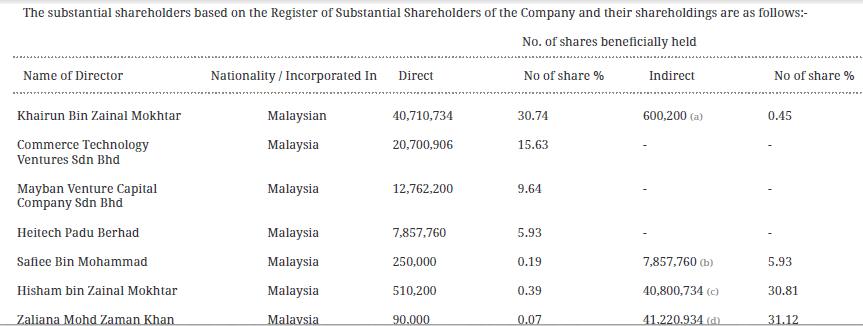
One of the shareholder and brother to Tricubes CEO, Khairun Zainal Mokhtar is Nor Yakcop's boy, Hisham Zainal Mokhtar by virtue of employment in Khazanah. Hisham was formerly a Vice President in charge of finance in Tricube before leaving in 2004/5.

Did Hisham secure finance for Tricubes through his Khazanah connection?

His close circle of friend is the former CEO of Mavcap, Husni Muhammad Salleh, who had just left to join Teraju in April. Interestingly, another shareholder of Tricubes is Maybank and CEO of Maybank Investment Banking is friends to both Hisham and Husni, Mohd Farid Alias.

Is cronyism the manner Tricube received their funding or viability?

This also leads to another issue of public interest but slips Tony Pua's radar. As Dato Najib's newly appointed CEO for Teraju, Husni is in a questionable position.

Husni is only a corporate man devoid of soul and has no activist background to champion the Bumiputera cause. There is only a small role for venture capital in Teraju. It is more to do with policy development and monitoring.

If Tony Pua and opposition press is honest and sincere, that should have been the issues raised. Would he care for Bumiputera interest issue?

Lastly, another outstanding issue is the MAS losses, which is nothing more than a complete lie.

Till today, no one has been able to show how did the accusation of RM8 billion loss by Tan Sri Tajuddin Ramli come about? The profit and loss figures through the years only shows the total PBT loss was RM702 million and total PAT loss was RM908 millions.

The big item is the RM5 billion asset shifting under wide unbundling of asset. But that's a balance sheet item with no profit and loss implication.

The accusation on Tajuddin was a scheme concocted by lawyer Rosli Dahalan involving former CCID Dato Ramli Yusof, the titled pauper Prof. Dato Din Merican who revive himself by linking with the sodomist Dato Seri Anwar Ibrahim, and spin meister Raja Petra.

The attempted the initial brouhaha using Salehuddin Ayub but he failed to make an impact.

It was only the loud mouth old idiot, Tan Sri Robert Phang who believes in the perception by these conspirators. He politicised the issue without realising there is no case and whatever case is a repeat of a case against Tajuddin that was thrown out by the ICC.

The suspicion is Rosli Dahalan is churning legal fees from MAS. Churning means multiple charging legal fees for an almost same work done.

Read back past postings here, here, here, here and here. Continuation coming up.

These are cases of the public being deceived by perception play without bothering to understand the facts and figures and teh right story.

The public succumbed to conspirators storyline dedicated to politicking and blaming political opponent than seriously addressing corruption and other issues of public interest.

As a result, the real culprit, which is the individuals, get partisan support and corruption and matters of public concern are not addressed.

Malaysian must start to express their disatisfaction with overpoliticking, excessive political issue dominating public discussion, and endless revolting game of blame that does not objectively solve problems and build a nation.

Do it, or the further we go, it will be an irreversible decay.


* Edited 4/5 8:30 AM

My Say